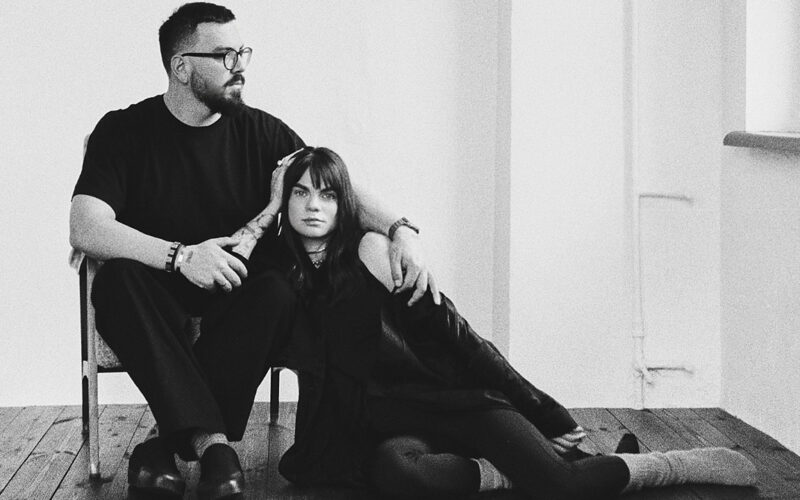
Olga Samokhvalova is a colorist and co-founder of the LUMEN salon. She began her journey in Mariupol, went through the challenges of relocating during the war, and today creates a space where women receive not only professional care but also a sense of confidence and strength. In this conversation, she shares moments of professional self-discovery, ethical choices in complex coloring, her experience of work with cultural initiatives that combine beauty with support.

Can you recall the first moment of professional “recognition of yourself”: where were you, what exactly did you do with a client’s hair, what feedback did you receive, and what from that experience still lives in your work today?
I remember my first moment of professional “recognition of myself” very clearly. It was back in Mariupol, at the very start of my career. A client came to me who was afraid of coloring but dreamed of a renewed look. I suggested a complex yet soft and natural coloring that was meant to highlight her features and give her confidence.
When she saw herself in the mirror, she burst into tears of happiness. Her words: “I haven’t felt this way in such a long time” stayed with me forever. At that moment, I realized that my work is not just about color or technique, but about the feeling I give to a person.
Since then, I have always worked with attention to detail, listening to the client and searching for an individual solution. This philosophy — seeing the person, not just the hair — remains at the core of my work to this day.
Relocating during the war changes one’s perspective. What skill did you have to relearn as a master and as an entrepreneur? Name one decision you gave up on and one you dared to implement — with a concrete result for LUMEN.
Moving from Mariupol to Kyiv during the war changed my approach. At first, I worked with a well-known stylist and gained valuable experience working with clients of a new level. When, due to the war, his salon was forced to close, my colleague — a top stylist — and I decided to take the risk and create our own space.
I gave up the familiar role of being “just a master” and, for the first time, took on the responsibility of organizing a space and running a business. That’s how LUMEN was born — a space where masters work in their own rhythm and style, and clients receive individualized service in a calm, thoughtfully designed atmosphere. This model gave us flexibility and a quick start in the new reality.

Complex coloring often requires a compromise between eco-friendliness, durability, and hair health. Can you share a real case: what was the starting point (the base), which approaches did you consider, why did you choose the specific solution, and how did you explain the pros and limitations to the client?
Recently, a client came to me with dark natural hair and many years of at-home dyeing. She dreamed of a cool blonde — but the starting base was complicated: uneven pigment, dry sections, and varying porosity.
We considered three approaches:
– aggressive lightening in a single session;
– gradual lightening with intermediate tones;
– gentle lightening combined with restoration.
I explained to the client the pros and cons of each option: a quick result — but with a risk to the hair structure; gradual — more time-consuming, but preserving health. We decided on gradual lightening using restorative additives in the coloring process and professional treatments between sessions.
I honestly told her that we wouldn’t achieve the perfect cool blonde immediately, but even after the first session her hair would look softer and healthier. This approach preserved the hair’s integrity and gave her a predictable result without shocking the structure.

What, in your opinion, helps colorists develop a sense of color and tone? What common mistake do you most often notice among young colorists, and how do you help them correct it?
To develop a sense of color and tone, I always recommend one simple yet effective practice: observe palettes not only in paints but in real life — in nature, fabrics, and light. Take a photo or an object, break it down into shades, and determine which tones are warmer, cooler, deeper, or lighter. This trains the eye and builds confidence when selecting colors for clients.
The most common mistake among young colorists is rushing and working “by formula,” without considering the hair’s base or structure. I always emphasize: hair is a living material, not a diagram. It’s essential to view it as a canvas — to assess its condition, previous colorings, porosity, and pigment.