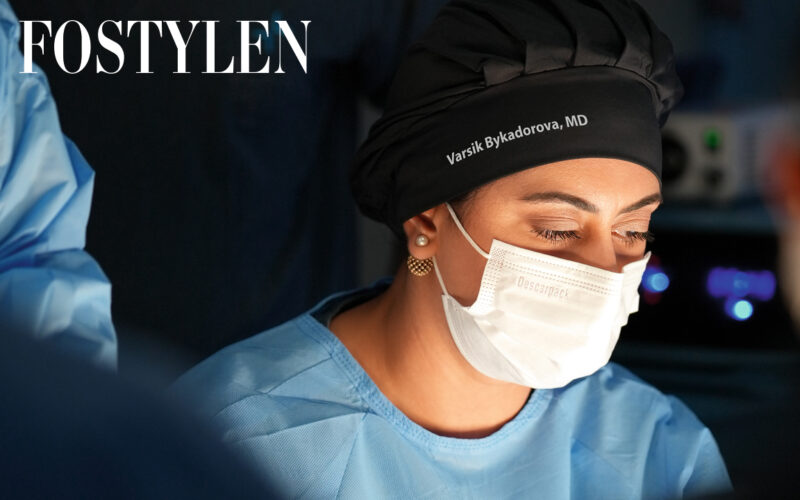
In a world where aesthetic medicine is evolving at unprecedented speed, the name Varsik Bykadorova has become a marker of both professional integrity and technological mastery. A PhD, a top-tier surgeon, and a renowned VASER trainer, she has built a career that seamlessly blends the precision of classical surgical practice with the cutting-edge techniques of modern liposculpture.
More than 4,000 patients have entrusted her with their transformations — and each one has become a story not just about beauty, but about the restoration of a woman’s inner strength.

You’ve spent more than two decades in surgery. Was there a defining moment that ultimately shaped your specialization?
First of all, I always knew I wanted to be a surgeon. From the moment I entered medical school, the path felt unmistakably clear: my calling was surgery, not therapy. I needed dynamism, movement — the ability to act decisively and make choices in real time.
As for plastic surgery, it had captivated me since my youth. But twenty years ago, the field wasn’t nearly as advanced or accessible as it is today. So the natural first step was to go through the rigorous school of general surgery. I completed my residency in that specialty and then spent 17 years working in a state hospital as a general surgeon, while simultaneously practicing plastic surgery in private clinics.
That foundation became the bedrock of who I am as a specialist. A background in general surgery is invaluable for any plastic surgeon — it shapes your ability to accurately assess patients, respond quickly, make sound decisions under pressure, and manage complications effectively when they arise.
You often emphasize a deeply individualized approach to every woman you work with. What matters most to you during that very first consultation?
For me, the most important thing is that the patient and I truly hear each other. I need to understand her expectations and the result she envisions, all while taking into account her unique anatomical features. At the same time, the patient needs to understand me — what I can realistically offer within the possibilities of her body.
Ultimately, it all comes down to mutual understanding. When we genuinely listen to one another, we can move forward as partners, each taking responsibility from our side and working together toward a shared goal: achieving the best possible outcome.
How often do you have to decline performing a procedure, and what are the most common reasons for that?
I only refuse when I genuinely believe the procedure is unnecessary. For example, in cases of breast augmentation, if I’m looking at a beautifully proportioned body with naturally harmonious breast shape — one that truly doesn’t need alteration — I will always tell the patient that honestly.
Yes, sometimes a patient may go to another surgeon and proceed with the operation anyway. But my professional and ethical stance remains the same: if I see that surgical intervention won’t enhance the result — and could in fact compromise a woman’s natural beauty — then I not only have the right, but the responsibility, to say no.

How does a woman’s psychological state change after a delicately performed aesthetic correction?
The shift in a woman’s emotional state is often profound — and that’s not just my observation, it’s what patients themselves tell me. They say they want to linger in front of the mirror a little longer, to look at themselves without clothes, to rediscover their own beauty through a new lens. Confidence emerges. Their inner world changes — and with it, the way they interact with others, and the way the world responds to them.
A sense of self-assurance, happiness, and inner satisfaction grows noticeably. Sometimes the difference between “before” and “after” is visible without a single word being spoken. And of course, witnessing these transformations is deeply inspiring for me as a specialist.
What internal fears do patients most often bring with them?
The most common fear, without question, is anesthesia. It’s the aspect patients worry about the most. There are also concerns about recovery — how the rehabilitation period will unfold, how comfortable it will be, and how much time it will require. And of course, they’re deeply focused on the final result: what it will look like and whether it will meet their expectations.
What truly matters is giving them space to voice their concerns — explaining the process and helping them feel safe and informed.
Why has the Mommy Makeover become one of your signature specialties?
Because as a woman, I understand other women deeply. I know how essential it is to restore yourself after pregnancy and childbirth — to reclaim confidence, to take pleasure in your own reflection again. It’s not just about external changes; it’s about inner balance, about returning to yourself.
That’s why this field is so meaningful to me. I know firsthand how transformative this journey can be, because I’ve gone through similar stages myself. And perhaps that personal experience is what ultimately shaped my desire to help women feel harmonious, confident, and whole.

You work with VASER and High Definition Lipo. What is the key difference between modern liposculpture and traditional liposuction?
I work exclusively with VASER — and only with VASER. I don’t offer any other type of liposuction because I consciously choose the most advanced technology available. What’s the difference? VASER is an American ultrasonic device and one of the most effective systems in the world. It allows me to perform liposculpture with top-tier precision, and to master it I trained in Brazil, Dubai, Sweden, and several other countries.
Ukrainian women no longer need to travel to Brazil to achieve beautifully sculpted body contours — we can create those results right here at home.
VASER works selectively: it doesn’t damage nerves or blood vessels, and it doesn’t “melt” fat. Instead, it emulsifies fat cells using ultrasound, allowing for a smooth, gentle extraction. The method is minimally traumatic, offers a shorter recovery, greater safety, and more refined aesthetic outcomes. It also allows the surgeon to work within different layers of subcutaneous fat without harming surrounding tissues.
But it’s essential to remember: the device is only a tool. What truly matters is the surgeon’s expertise. In unskilled hands, even the most advanced technology can lead to complications.
As for High Definition Lipo, I had the privilege of learning directly from the creator of the technique. For me, that is both an honor and a point of deep professional pride — because he taught me the very methods that today make it possible to achieve truly striking, sculpted, and beautifully defined results.
How do you choose the right method for a particular patient — surgical or device-based?
I always tailor the approach to the individual woman sitting in front of me. It may be a surgical intervention or a device-based procedure — it all depends on the concerns we’re addressing and the result the patient hopes to achieve. From there, I create a personalized, often combined strategy: blending surgery with advanced technologies to deliver a result that feels as natural, safe, and effective as possible.
What inspires you and gives you the strength to work in such a demanding and responsible field?
So many things inspire me — my family, my friends, travel, continuous learning. But professionally, my greatest source of inspiration is my patients.
When they come back and tell me how much happier they’ve become, how their lives have changed, how a new sense of inner confidence has emerged, how differently the world responds to them — that is priceless. They share that they linger in front of the mirror more often, admire their renewed bodies, and rediscover themselves with joy. That feeling, that energy they bring back to me, is what fuels my work every day.
Moments like these give profound meaning to everything I do.

What message would you most like to share with women who are unsure about whether to change something in their bodies?
For me, the main point is this: if a person has the vision, desire, and opportunity to change something — they should use that chance. This applies to every part of life, including surgical interventions. If something doesn’t feel right, if there is an inner longing for change, and if health, circumstances, and finances allow it — why not?
I hear the same confession over and over again:
“Why did I wait seven years? Why didn’t I do this sooner?”
or
“Why did I lose five years when I could have changed this long ago?”
It’s probably the most common sentiment my patients share.
And that’s why I want women to know: if you truly want change — if the desire is there and the possibilities are there — take action. Don’t let time slip away. You deserve comfort, confidence, and happiness now, not “someday.”