
The world we live in has become faster, louder, and visually flawless — yet increasingly opaque on the inside. In this reality, people are no longer looking for advice as much as they are searching for clarity: Who am I? Where am I going? And why does my life look the way it does?
Marina Stepanian is a digital psychologist working at the intersection of intuition and analytics. Her professional path was anything but conventional — from pastry chef and café owner to decoding the inner rhythms of human life. In conversation, she speaks about numbers as a language of self-knowledge, about balancing control with trust in life, and about why reconnecting with oneself has become essential in the age of curated screens and perfected images.

Before digital psychology, your career was rooted in a completely different field — you worked as a pastry chef and even owned your own café. How did that experience lead you to working with the human inner world?
They may seem like different worlds, but they don’t contradict each other. Pastry will always be pastry, psychology will always be psychology. I still don’t rule out opening a dessert café again one day — I love giving people emotions, creating a sense of joy, comfort, and sensory pleasure.
Digital psychology exists on a different plane. It became a form of inner transformation and self-realization for me. I’ve been interested in psychology since my youth, but I encountered the language of numbers only relatively recently. Before that, the phrase “we are all made of numbers” felt more like a metaphor tied to the material world. Only when I went deeper did I truly understand its meaning.
Our lives are built on cycles, phases, and rhythms. And when a person begins to understand their personal numbers, they gain keys to many inner locks — from deeper self-awareness and life direction to choosing the right partner, both in business and in personal relationships.
Was there a moment in your life when an external impulse — a person, a conversation, a single insight — helped you see your path differently?
Like many people, I work with a coach. She played a significant role in helping me dive deeper into the world of numbers. Sometimes a person can search for themselves for years — and all it takes is one small impulse for everything to shift.
We often see examples of people who spend decades in one profession — twenty years in banking, for instance — and feel internally empty. Then something clicks: the profession changes, the lifestyle changes, the worldview shifts. I believe each of us comes into this world with a specific mission. And it seems that for me, the time has come to recognize and fully step into mine.
Digital psychology sounds like a discipline of the future. What made it feel like the right choice for you?
I love psychology in all its forms. But by nature, I am an analyst. I’m used to researching, calculating, structuring, and identifying patterns. My number of intellect is three — it’s about knowledge, logic, and analysis.
That’s why digital psychology felt so intuitive to me. It combines psychological depth with a clear system that allows you to see life patterns rather than the illusion of random chaos.
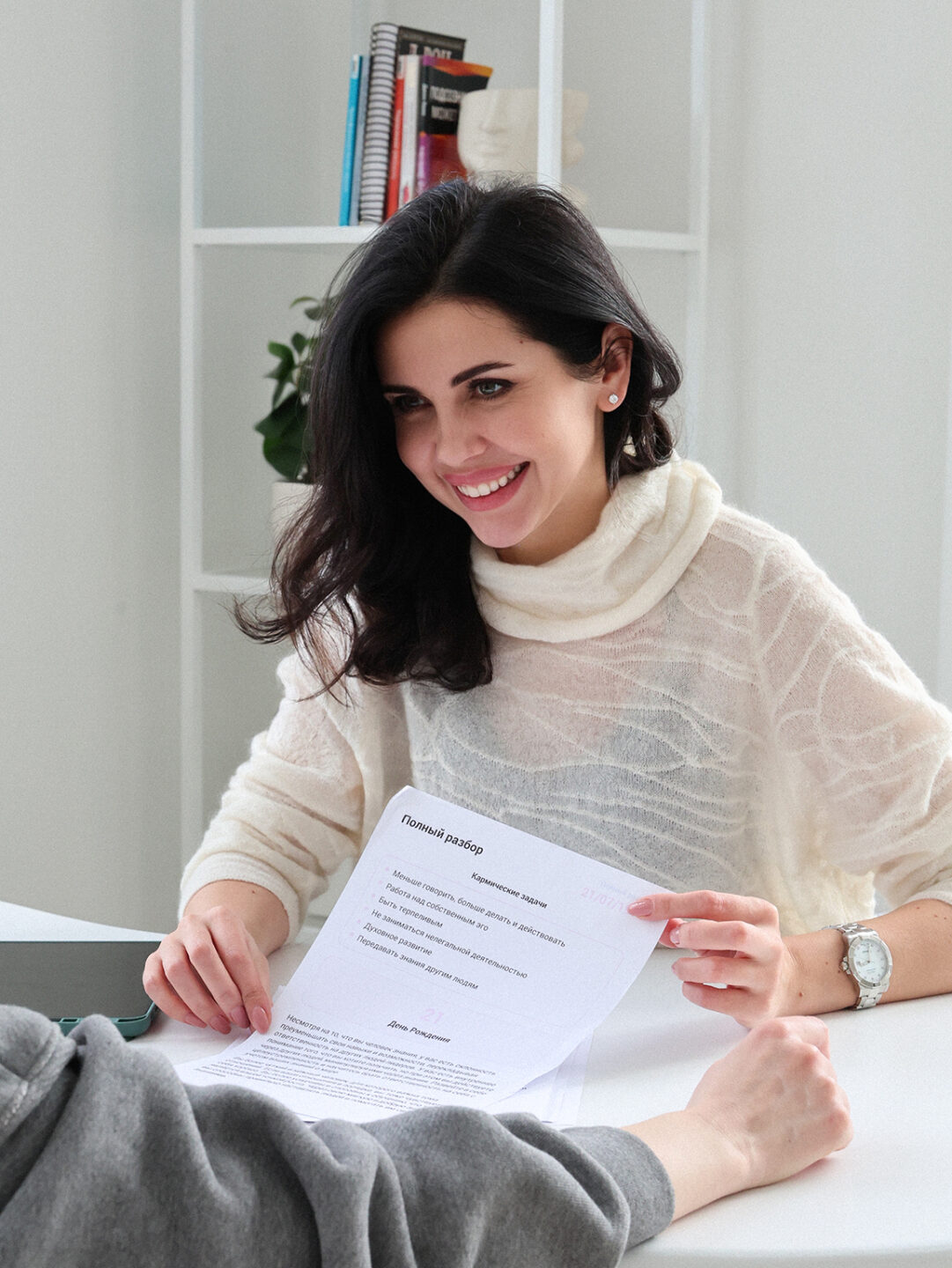
People come to you in a digital space, where personal, professional, and public identities often blur. What are the most common questions clients bring today?
Above all, people are looking for grounding — especially now. They want to understand their strengths and vulnerabilities: where they need to stand firm and where they can soften and grow.
When there’s clarity about one’s actions, lived experience, and areas still to be developed, something shifts internally. That clarity creates energy. Some people learn to build structure, strategy, and control; others learn to release control and delegate. Ultimately, this process leads to inner balance.
Many still view digital psychology as a “simplified” format. How do you explain the depth it can offer?
Skepticism is a natural reaction. People often perceive anything new as a simplification, regardless of whether we’re talking about digital or classical psychology. Doubt disappears only when results appear.
It’s not entirely accurate to directly compare digital psychology with classical psychology — they use different tools, address different levels of awareness, and serve different purposes. And that’s precisely where the value of each approach lies.
How has the modern individual changed under the influence of social media, constant availability, and information overload?
Psychological states have shifted dramatically in recent years, and social media has played a major role. Idealized images of life, family, appearance, and success often undermine a person’s real sense of self.
The boundary between screen and reality is increasingly blurred. Classical psychology — when practiced at a high professional level — helps a person return to themselves and reconnect with genuine desires. Digital psychology, in turn, helps identify personal purpose and direction.
Beyond methods and techniques, what defines success in your work as a digital psychologist?
For me, success means showing a person their path. Helping them uncover their strengths and gently reinforce their weaker areas. Supporting harmony in relationships — whether it’s finding the right partner or deepening understanding within an existing one.
The same applies to business: healthy communication with partners, clarity around one’s role, and awareness of growth points. When a person begins to live in alignment with themselves — that’s real transformation.